.No I did not buy a lottery ticket. I spent the $2.00 on a delicious doughnut at Tel Aviv Bakery on Devon in West Rogers Park. And I have money left over. I think I'll put it in the Pushka. However if I find a ticket in the street... well, you never know. I will check the numbers to see if I won. Whats that? You don't think it's very likely to find a lottery ticket on the street? You're kidding - Right? Likely??? Well... it may not be likely. But it's possible. People lose things all the time.
Update
Did not find a lottery ticket. So I didn't win anything. On the bright side, it didn't cost me anything either.
Tuesday, January 12, 2016


Tuesday, January 5, 2016
Public Rebuke of Rabbi Daniel Eidensohn

The controversy over the release of a woman from her status as an Agunah has been the subject of the Daas Torah blog run by Rabbi Daniel Eidensohn for quite some time now. In virtually all of his posts on the subject he wasted no time besmirching the reputation of 2 respected Rabbis - elders in their 90s - for permitting that woman to re-marry.
He and many other rabbis rejected outright the Heter (Halachic permission) they used for her to remarry. Since she has remarried based on that Heter, Rabbi Eidensohn and the rabbis who rejected it characterize this couple as adulterers in the Halachic sense.
He and many other rabbis rejected outright the Heter (Halachic permission) they used for her to remarry. Since she has remarried based on that Heter, Rabbi Eidensohn and the rabbis who rejected it characterize this couple as adulterers in the Halachic sense.
I am not here to dispute or support that Heter. But even assuming Rabbi Eidensohn is correct, the way he is handling this is beyond disgusting. His latest post has actually asserted that he will no longer publish any comments critical of him. Thus it will be Rabbi Eidensohn that has the last word.
I responded nonetheless with the following:
You won't be publishing this, but I'm going to tell you anyway since you will in fact be reading it before you delete it.
It is not your view about the halachic issues involved here that is in question. You may in fact be right. Indeed the consequences of those actions are serious. It is the way you handled it by besmirching the Chashuva Rabbonim whose views and actions you criticized. In doing this in such a public manner, you have lost your Chezkas Kashrus among so many of your former supporters - of which I counted myself as one.
How sad it is for someone with your talent - and all the contributions you have made to Klal Yisroel in other areas - to have fallen so low. I cannot tell you how disappointed I am in you - someone I used to admire so much. I'm actually thinking about publishing this comment on my blog so that my views will be known by more people than you. Because you deserve a public rebuke.
Monday, December 21, 2015
Open Letter to Open Orthodoxy
By Rabbi Francis Nataf
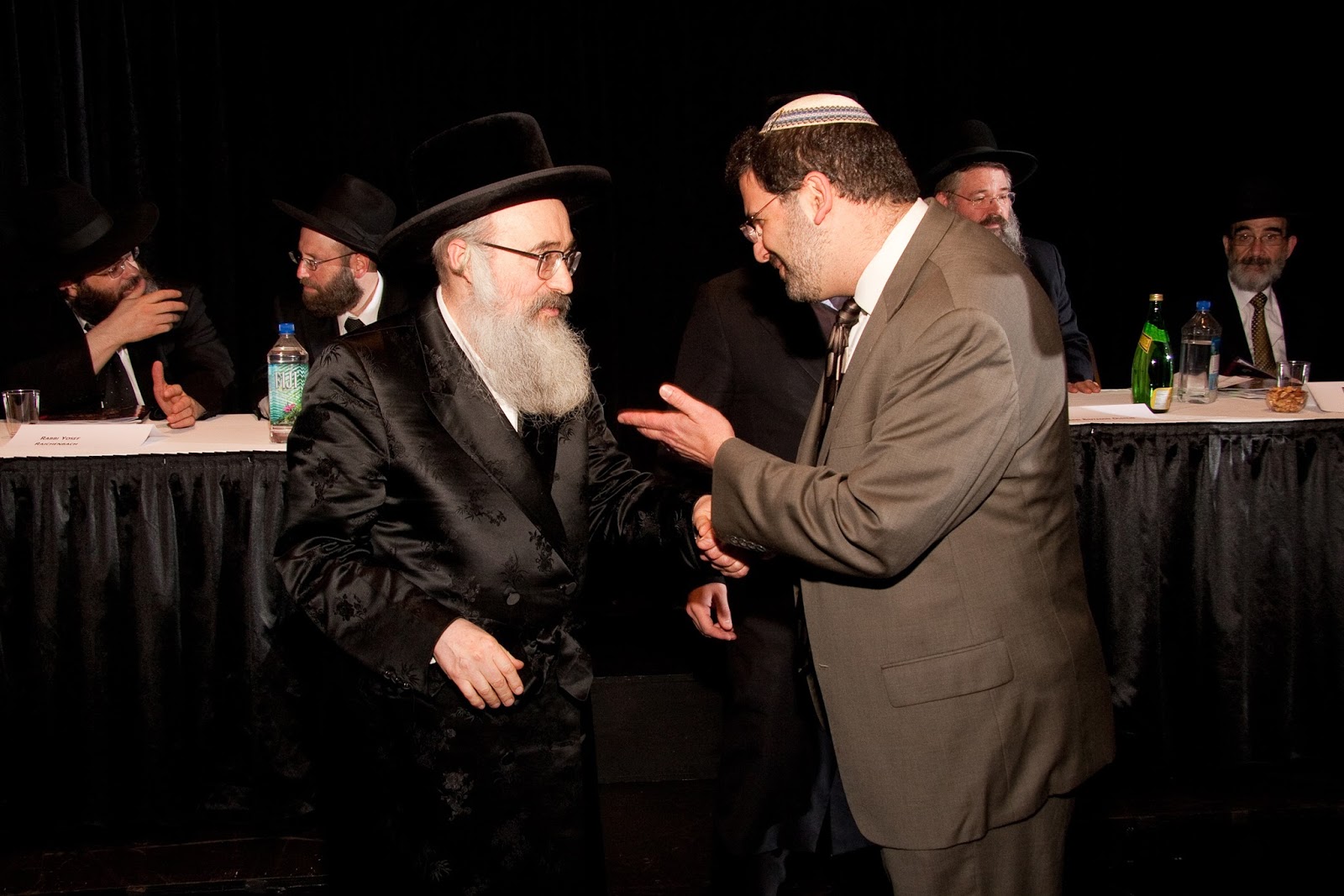 |
| Rabbis Eichenstein and Lopatin what once was - could once again be |
The following article by Rabbi Francis Nataf appeared in the
Times of Israel. It makes eminent sense to me. Despite my strong criticism of
the movement, I never wanted them to be ousted from Orthodoxy. To the contrary, I
practically begged them to stay. Unfortunately they have done nothing to allay
my concerns – concerns which many of us in the ‘center’ have expressed many
times. If they make these corrections they will be welcomed back with very open
arms. At least as far as I am concerned.
And I think many others who share my concerns. His words follow.
While I have decided
to maintain the public nature of this letter, I am pleased to report that it
has already elicited a positive response by at least one of the main leaders to
whom it is addressed. My hope is that its publication will help and not hurt
the maintenance of unity in the Orthodox camp.
While I have decided to maintain the public nature of this
letter, I am pleased to report that it has already elicited a positive response
by at least one of the main leaders to whom it is addressed. My hope is that
its publication will help and not hurt the maintenance of unity in the Orthodox
camp.
In a recent essay, I wrote about what I admire in Open
Orthodoxy (I have since learned that is a label that some of its leaders would
prefer to no longer use). No matter what happens in the future, I will continue
to admire these points and many others.
It is precisely because of my admiration for — and
sometimes even identification with — Open Orthodoxy that I write this
letter. I think you should already know that when the critique is coming from
people like Rabbi Shmuel Goldin and Prof. David Berger, it may be time to
listen. Besides long being identified with the liberal wing of Modern
Orthodoxy, both men have been known for their thoughtfulness, intellect and
sensitivity. At the risk of redundancy, I will add my name to those who feel it
is time for Open Orthodoxy to take stock of where it is, not just as a favor to
us, but — more importantly — as a favor to itself.
Much of what passes for critique these days is just
self-serving harangue and rabble-rousing. No doubt, Open Orthodoxy is tired of
having to deal with so much of that since its inception. And it could be that
after getting so much unfair criticism, it has become immune to all
criticism, even when it is in place. Yet our tradition tells us quite clearly
that the wise man loves critique. Difficult though it may be, I call upon you
to realize that there are some very important questions now being raised by
those who think of themselves as your friends.
Indeed, accepting the critique of others is what kept many
of Judaism’s most important movements within the pale, to the benefit of those
offering the critique, as well as those accepting it. It is what kept the
followers of Rambam from reducing all of Judaism to a metaphor for Greek
philosophy. It is also what kept the early Kabbalists from turning into
polytheists, substituting the sefirot for God Himself. More recently,
it is what kept Hassidut from antinomianism and its turning away from the
centrality of Torah study and observance. I need not point out that movements
that rebuffed legitimate critique fared less well.
Rabbi Goldin raised the issue of method, Prof Berger of
substance. To address the first, there are many — even within Open
Orthodoxy — who have misgivings about the confrontational style adopted by
several of its most prominent exponents. Personally speaking, I believe that
much more is accomplished by those that seek a broader consensus for moderate
change than those working for radical change within more narrow confines.
But
more immediately relevant is that if Open Orthodoxy cannot control its
firebrands from burning bridges to the mainstream, it should not be surprised
to wake up to a situation where these bridges no longer exist. In such a
situation, it will have defined itself out of Orthodoxy on sociological
grounds, if not necessarily on substantive ones.
Unfortunately, however, there are true substantive issues
that threaten to pull us apart as well. Prof. Berger focuses on the authorship
of the Torah and Yeshivat Chovevei Torah’s inability — or lack of desire
— to provide clear red lines on what is probably (along with the nature of
Halacha) Orthodox Judaism’s most important issue.
To be fair, YCT President
Rabbi Asher Lopatin endorsed the traditional understanding of revelation at
Sinai. But, by the same token, he has — so far — refrained from
placing any alternative as outside of Orthodoxy’s boundaries. This is not the
place to go into the intricacies of this issue, which I and others have
discussed in other forums. Suffice it to say that while Judaism’s red lines are
intentionally fuzzy, there is no question that they exist. And one of the major
items defining Orthodoxy as a movement has been its willingness to
unapologetically proclaim and defend those boundaries.
There are other issues, but my point is not to create a laundry list of complaints. It is to simply say that it is time to listen.
I appreciate the desire to hold on to people on the
religious and intellectual left. There has always been a tacit understanding
that an individual need not follow every belief or law to have a place within
the Orthodox community. Hence, all sectors of Orthodoxy would do well to continue
to make room for those Jews who disagree with us and to do everything we can to
make them feel welcome.
But there are limits. One of them is that the leadership, both in the yeshivot and in the synagogues, has always supported a series of public red lines that define the community’s contours. It is really not about defining others, it is about defining ourselves.
But there are limits. One of them is that the leadership, both in the yeshivot and in the synagogues, has always supported a series of public red lines that define the community’s contours. It is really not about defining others, it is about defining ourselves.
The point is that for Open Orthodoxy to be Orthodox, it
cannot be open to everything. And though it may hurt some people by saying so,
it will ultimately hurt many more if it does not.
Thursday, October 29, 2015
Supporting Israel: Clinton Versus Obama
 |
| Former President Clinton and Prime Minister Netanyahu |
The following Op-Ed by Gil Troy appeared today in JTA. Even though President Obama has been supportive of Israel in many ways, I think Gil's got it just about right. It follows in its entirety.
WASHINGTON (JTA) — By now it should be obvious how absurd it is to call President Barack Obama Israel’s “best friend” ever, as Thomas Friedman of The New York Times has claimed.
A Blame Israel Firster, Obama won’t use his moral authority to try stopping the instigators of this latest spate of violence, the Palestinians. Unfortunately he never learned from his Democratic predecessor how to tell the good guys from the bad guys in the Middle East.
While Bill Clinton also endorsed a Palestinian state, and also felt frustrated with Prime Minister Benjamin Netanyahu, he blamed the Palestinians for terrorism and Yasser Arafat for derailing the peace talks in 2000. Clinton finger-pointed when necessary, not always retreating into “cycle of violence” moral equivalences.
He distinguished between Israeli willingness and Palestinian foot-dragging. He never confused Israeli innocents with Palestinian terrorists. This Democratic president clearly stated that “the PLO must do everything it can to end terrorism against Israel.” With his down-to-earth “Bubba” style, he denounced terrorists as “the forces of doom and gloom,” while advising the Palestinians that “struggle and pain and destruction and self-destruction are way overrated, and not the only option.”
Bill Clinton was an empath. He conveyed his love for Israel with words, gestures and flourishes. Heartbroken when an Israeli fanatic assassinated his friend Yitzhak Rabin, Clinton captured the world’s anguish with his famous “Shalom, chaver” sendoff. On Saturday, Clinton will speak at a rally in Tel Aviv to mark the 20th anniversary of Rabin’s murder.
Clinton charmed Israelis, reassuring many who felt he pressured Israel to relinquish too much territory to the Palestinians. Even when Netanyahu’s obstructionism exasperated him, Clinton palled around with Bibi. Obama has scowled.
Visiting Israel in March 1996 following two suicide bus bombings, Clinton defied the Secret Service by visiting Bet Chinuch, a Jerusalem high school mourning three students. The president called two recovering victims on the phone. Later that day, and visibly moved, he told young Israelis: “We know your pain is unimaginable and to some extent unshareable, but America grieves with you.” He called terrorists “destroyers” gripped by “that ancient fear that life can only be lived … if you’re hating someone else.” He backed up his words with $100 million in anti-terror funding.
Clinton differentiated between Israeli openness, even if wary, and Palestinian resistance, even if camouflaged. My new book, “The Age of Clinton: America in the 1990s,” retells how when Arafat made his unprecedented 24th White House visit in January 2001, shortly before Clinton left office, the president was fuming. At Camp David the previous summer, Israeli Prime Minister Ehud Barak had offered to withdraw from most of the 1967 territories and compensate the Palestinians with land swaps. Arafat never even counteroffered.
The oleaginous terrorist tried flattering the president, calling him a great man.
“I am not a great man,” Clinton replied, “I am a failure. And you have made me one.”
Clinton later explained: “Arafat never said no; he just couldn’t bring himself to say yes.” Mourning Arafat’s “error of historic proportions,” Clinton would speculate, “Perhaps he simply couldn’t make the final jump from revolutionary to statesman.”
Also in January 2001, Clinton, in his characteristically colloquial way, warned the Palestinians: “There will always be those who are sitting outside in the peanut gallery of the Middle East urging you to hold out for more, or to plant one more bomb.” He begged them to resist those luring them to “the path of no.”
Today, Palestinians have again erupted in violence, but Obama lacks Clinton’s moral clarity.
“We continue to stress to leaders on both sides the importance of condemning violence and combating incitement,” Obama’s press secretary, Josh Earnest, has said. This mealymouthed amoralism reinforces Obama’s technocratic urging of both parties to try to “tamp down rhetoric that may feed violence or anger or misunderstanding.”
The Clinton-Obama contrast reflects two conflicting worldviews. Clinton entered office as such a national security novice that Ronald Reagan had to teach him how to salute. But Clinton’s passivity amid massacres in Bosnia and genocide in Rwanda transformed him. He realized that when America doesn’t lead, evil flourishes. He became a neoliberal interventionist, deploying the military to advance Western values in Kosovo and expressing zero tolerance for terrorism.
A postmodern power skeptic, Obama harbors more doubt about Western values and America’s ability to lead the world constructively. Emphasizing America’s limits, morally and strategically, Obama wants to woo the developing world.
Regarding the Middle East, Obama should learn from Clinton that Palestinian desires to exterminate Israel — expressed through incitement and terrorism — remain the biggest obstacle to peace. If Obama, like Clinton, held Palestinians responsible for turning toward terrorism, he would be treating them as mature decision makers, not infantilized victims.
Even with Obama’s military generosity to Israel, a true friend, let alone a “best friend,” would not always blame Israel first, or obscure Palestinian responsibility by blaming both sides, especially when Palestinians attack Israel. Muddled morality emboldens Palestinian terrorists, who interpret such dithering as greenlighting their bloodlust.
Obama should duplicate Clinton’s moral clarity. Obama must finally, belatedly, blame the Palestinians directly, pressuring Palestinian Authority President Mahmoud Abbas and company to stop the violence. Obama should disagree with Secretary of State John Kerry, who blamed the settlements — not lies about the Temple Mount — for this latest eruption.
Clinton understood something Obama cannot comprehend: The world’s one-sided condemnations of Israel compound the trauma of Palestinian terror, reminding Israelis of the long history of anti-Semitic oppression — which Clinton frequently acknowledged. As a lonely, too-often-abandoned democracy, Israel responds to support, warmth, protectiveness. Even though many Israelis disagreed with Clinton’s policies, they trusted him, loved him and thus were willing to compromise.
(Gil Troy is a professor of history at McGill University and a visiting scholar at the Brookings Institution. His newest book, “The Age of Clinton: America in the 1990s,” was just published by St. Martin’s Press.)
Thursday, October 22, 2015

Sunday, October 18, 2015
Orthodox Jewish women, “leadership” and Myers-Briggs
by Julie Rosenzweig

The following is a brilliant article from a website called Medium.com about the role of Jewish women in the 21st
century. It was written by Julie Rosezweig who describes herself as “Jerusalemite, translator/mom”. It is a lengthy article
but well worth the read. It follows in its entirety.
For a decade or so now, introversion — somewhat out of
character — has been making a public case for itself. An acclaimed 2003 essay
in The Atlantic sparked a legitimization process that has culminated in
Susan Cain’s Quiet Revolution.
Those of us who hated class
participation in school are feeling vindicated as major media outlets discuss
the ways in which introverted students are unfairly penalized by it;
an aversion to small talk is becoming a mark of distinction rather than of
inadequacy; and the idea that one can be
a leader without having an alpha personality is gaining currency.
Judaism has always valued quietness and non-pushy
leadership. Sound bites to that effect can be found in Ethics of the
Fathers:
“All my days have I grown up among the wise and I have not found anything better for a man than silence;”
“ One who runs away from honor will find honor chasing after him. One whochases after honor will find honor running away from him.”
“All the glory of a princess is within” (“Kol kevuda bat melech pnima”).
It’s easy enough to relate to the first two of the above
quotes. However uncritically we accept prevailing assumptions about innate
“leadership ability,” we tend to be pleased — after the fact — when some strong
but silent type carries the day. The idea of quiet integrity — of leading by
example rather than by virtue of personal charisma or will to power — isn’t
really all that hard a sell. Hence the broad public resonance of Susan Cain’s
initiative.
The third quote — the one about the princess, a stand-in for
women as a group — may, by contrast, seem opaque or problematic to non-Jews or
to non-Orthodox Jews, and may even have become something of a trigger to those
who identify with “liberal” or “open” Orthodoxy — i.e., to Orthodox feminists.
It is a quote that gives expression to aspects of women’s
nature that Orthodoxy takes for granted and proposes to accommodate (obviously,
a fraught issue for those who object to the idea of “women’s nature”).
It is also a quote that is used to insist on women’s
adherence to a stricter dress code than that which Orthodox Judaism mandates
for men — a code that is sometimes spelled out in centimeters and illustrated
via humiliating diagrams; it is a quote that is used to quell (or attempt to
quell) some women’s sense of being left out at synagogue.
I have issues with Orthodox feminism in its current form;
yet even I feel a little rankled when I hear kol kevuda bat melech pnima.
There is a religious Israeli women’s magazine called Pnima (“Within”)
which I wouldn’t touch with a ten-foot pole. I don’t like being told my place; no
one does.
But I think Orthodox feminism has focused way too much on
the extremes to which some segments of Orthodoxy take the reclusive-princess
concept. I do think that it has much to learn from the first two quotes.In short, it could use a good dose of Quiet Rev.
As a movement, Orthodox feminism has advanced a number of
admirable objectives, such as helping agunot (women “chained” to
husbands who refuse to grant them a Jewish divorce), making synagogue more
welcoming to women, and opening up to women the world of Talmud study, which
had long been restricted to males.
Unfortunately, over time the movement has adopted an
increasingly extroverted orientation. This is a problem, not in a “strident
feminists get on my nerves” sense, but because a preoccupation with the visible
public roles that Orthodox women might conceivably occupy is discrediting the
movement, dumbing it down, making it uncomfortable for Jewish women who don’t
fit a specific personality profile, and deflecting attention from actual women’s
Torah scholarship (as opposed to the credential that qualifies one for a
“leadership role”).
I will discuss below how Orthodox feminism’s attempt to
extrovertize women’s role in the synagogue can make Orthodox women
uncomfortable; I will then look at how women’s Torah/Talmud scholarship is
being undermined by an unhealthy fixation on publicly-visible roles for those
who pursue such scholarship.
The song-and-dance imperative
An enthusiastically-received essay that
was featured by the Times of Israelabout a year ago paints — unwittingly — a
troubling picture of what shul life under a highly extroverted Orthofem regime
might look like.
The author describes a situation in which a Torah scroll has
been passed to the women’s side of a liberal Orthodox synagogue so that the
women can dance with it on Simchat Torah (an exclusively male custom until the
advent of Orthodox feminism) — but most of the women present turn the offer
down.
The essay’s author, acting as a kind of gabbait for
the women of her shul, found this objectionable and undertook to persuade,
cajole and bargain with the recalcitrant women. This despite acknowledging
objective reasons why women might decline the privilege of holding the Torah
scroll, such as its heaviness and the fear of dropping it — a fear that would
be quite natural for those who have little or no experience handling the sacred
object.
She was dissatisfied with — and rejected — a proposed
solution in which women would simply dance around a table on which the Torah
scroll had been placed. It was that important to her to see no individual woman
refuse the role — a very public, attention-attracting role — of holding the
Torah scroll in her arms and dancing with it in the synagogue setting.
Of course, there are reasons other than the weight of the
Torah scroll why Orthodox women might prefer not to adopt or mimic this
particular male custom. Some are reasons of personal temperament (an
introverted woman might be perfectly happy standing on the sidelines, observing
the action), while others have to do with Orthodox Judaism’s gender
distinctions.
Orthodox Jewish men are expected to pray three times a day
with a quorum, and to set times for Torah study within their work/life
schedule. Women (though they are also expected to pray daily and though many
also engage in serious Torah study) are exempt from these specifically
time-bound commandments. They have other duties which are no less important.
But these duties (centered around the home and the care of
young children) are not bound up with the Torah as a physical object, or with
the synagogue/beit midrash as a physical place. In short: they are not publicduties.
I would venture to guess that that is why many — perhaps most — Orthodox women
feel uncomfortable taking on the shul-based song-and-dance aspects of Simchat
Torah. It is not because they feel inferior, or that their duties and
activities as Jewish women are less important or less worthy of celebration. It
has to do with a sense of impropriety: those who are commanded in and who
fulfill “public” mitzvot — who make the effort to attend synagogue
services three times a day, every day, and who keep to a Torah study schedule,
rain or shine, throughout the year — are entitled to celebrate publicly and
physically with the object of their devotion.
It is often
argued that today, when women are active in all secular spheres and
able to distinguish themselves in prestigious occupations, it makes no sense to
exclude them from active synagogue roles. Orthodox feminists maintain that such
women are offended by this form of exclusion and that it alienates them from
synagogue life.
However, this argument can easily be turned on its head.
Women who are challenged and fulfilled professionally (in addition to their traditional
home-based roles, which they are seldom willing to entirely relinquish) are unlikely
to be seeking their intellectual/spiritual salvation in shul
frameworks contrived for the sole purpose of enabling them to mimic men.
Orthodox feminists have made women’s ritual inclusion into
a fetish. The childish, tit-for-tat idea that women must do whatever men
do, and that theymust especially do the public things that men
do, is insulting to Orthodox women who are happy with what they already do, and
particularly objectionable to those women who neither seek nor find
satisfaction in highly public roles.
I am not trying, here, to summarily condemn Simchat Torah
dancing on the women’s side of the mechitza, with or without a Torah scroll.
Those women who get a spiritual high from cradling the Torah scroll in their
arms are fully entitled to the experience. Just don’t impose it on me, or
judge me unfavorably for not participating.
I’m sure the author of the essay meant no harm. But there is
a mindset that wounds without intending to do so — it wounds individuals by
making incorrect assumptions about their desire for public attention, and it
hurts society — including Orthodox Jewish society — by privileging the
outward, the extroverted, over the inward and introverted.
Contrived “spiritual leadership”
Back in the 1990s, when the idea of women’s Talmud study was
gaining traction, a Jerusalem-based institute called Nishmat developed a
program to train and certify yoatzot halacha — female halachic “advisers” — in
the sphere of taharat hamishpacha (Jewish family purity).
The candidates recruited for this program were the crème
de la crème of erudite Orthodox Jewish womanhood at that time. These were
women who already possessed impressive Torah-study backgrounds in areas where
females had long been able to distinguish themselves. What the Nishmat program
offered was an orderly framework in which women could study Talmud — a sphere
of learning that had traditionally been restricted to men — and emerge with a
credential.
In a 2013 Jewish
Week article, the program’s co-founder, Rabbanit Chana Henkin, sets forth
the program’s original rationale: that of creating “a new religious leadership
role for Orthodox women,” one that would “meet a need.” Henkin portrays the
pre-yoetzet world as one in which women lacked “a properly trained,
rabbinically-sanctioned female address” for family-purity issues, and in which
“women felt uncomfortable discussing intimate details of their lives with
rabbis,” resulting in “improper observance and, often, personal suffering.”
Accordingly, the women admitted to the Yoatzot Halacha
program are expected, on graduation, to serve the Jewish community in very
specific ways — as counselors fielding taharat hamishpacha questions
via a hotline that Nishmat set up for the purpose; as knowledgeable go-betweens
for women in need of rabbinical consultation; and as lecturers and advisers to
women in their local communities.
To this day the Yoatzot Halacha program is Nishmat’s
flagship endeavor, and the yoetzet halacha title is an esteemed one in modern
Orthodox circles. I share that esteem, and in no way wish to belittle or
disparage the program itself, or anyone involved with it.
What I would like to call attention to, however, is the
discourse of “religious women’s leadership” of which the program is a part — a
discourse that requires scrutiny.
One can hardly fault a framework for training women to meet
actual needs on the ground. Nor is it unreasonable to expect, as the Yoatzot
Halacha program does, that applicants will possess the skills necessary for the
task in question— including interpersonal skills.
One can, however, wonder what would happen to an applicant
who simply wished to study the subject matter but had no desire to serve the
public via the channels marked out by the program. Would she be rejected? Does
a desire to engage with Talmudic texts at a high level necessarily go hand in
hand with an inclination for serving as an accessible, and even highly visible,
public resource? Should it?
And is a commitment to visible public service such as
prospective yoatzot are expected to demonstrate, demanded of men when
they undertake advanced yeshiva studies?
The keyword that pops up continually as one peruses the
websites of the various women’s advanced Torah study programs is leadership.
Again and again we are told that the women who participate in these programs
are chosen not just for their scholarly potential, but also for their
“leadership ability.” Nishmat’s
Yoatzot Halacha program requires it; Midreshet
Lindenbaum’s Halachic Leadership program requires it; even Matan,
which offers classes to less-Jewishly-educated women in addition to its elite
Beit Midrash programs, and which tends to emphasize “enrichment” over
“utility,” aspires to be a “breeding
ground” for women “leaders.”
The preoccupation with “women’s leadership” reaches its
apotheosis, of course, in the Maharat program at Yeshivat Maharat, whose avowed missionis
to provide a “credentialed pathway” so that the Orthodox Jewish community can
“attract the best and brightest [women] into the ranks of its leadership.”
(Maharat is a Hebrew acronym for “female halachic spiritual Torah leader.”) The
institution’s founders “sought to provide a path so that women could
achieve positions of leadership within the Orthodox community that were on par
with the rabbi.”
Now, introverts aren’t necessarily turned off by the word
“leadership.” What might well deter them from a study program, though, is an admission requirement that
they “aspire to serve as spiritual leaders.” For sure they would be repelled by
an institution whose website proclaims such a requirement at the top of every
page. (see logo above)
Would it be so terrible for a woman to simply be a dedicated
learner, with no aspiration to be a dynamic spiritual leader? Couldn’t a
dedicated learner grow, over time, into a different kind of leader — a strong
but silent one? Couldn’t she even surprise everyone — including herself — by
suddenly turning into a dynamic leader at some date far into the
post-graduation future, under the right circumstances? Why jump the gun?
I’m sure that some men’s Torah study programs talk about
leadership, building a “young leadership cadre,” etc., in their marketing
material. But where men‘s learning is concerned, I believe that this really is
just marketing, and not the essence.
In the male Torah world, no one thinks that a four-year
quasi-academic program, however rigorous, qualifies one to be a “spiritual
leader,” dynamic or otherwise. At most, it would qualify one to be a teacher,
and provide one with a basis for further intellectual/spiritual growth. In
fact, the very term “spiritual leader,” when applied to young women (or men)
who have trained for the specific purpose of functioning in that capacity, is
embarrassing.
Nor does the male Torah-scholarship trajectory involve
demonstrating leadership potential in a simplistic, college-application-essay
kind of way. No particular personality type is preferred. Though if anything,
the intensive, single-minded effort needed to achieve profound Talmudic
expertise would seem to favor those who shun the limelight — those with sitzfleisch.
Where does the “visible public role” approach — i.e., the
extrovert approach — to advancing women’s Torah scholarship lead?
It leads to a devaluing of women’s Torah scholarship — as
may be seen in the way that the yoetzet halacha role is being appropriated or
co-opted by other frameworks that feature a “visible public resource” component
similar to that of the yoetzet, but without the element of Talmud study.
One such framework is the NILI hotline, in which
“trained kallah teachers” offer a family-purity “resource” to Orthodox women in
the Chicago area that mimics the service offered by yoatzot halacha.
Kallah teachers — women who instruct soon-to-be brides on
the basics of Jewish family purity — may be highly educated, Jewishly or
otherwise, in their own right; but their training for the specific task of
premarital instruction entails no rigorous textual component or quasi-academic
credentialing process.
In fact there is no standard curriculum for the training
of kallah teachers. In past generations, women presumably learned family- purity
praxis from their mothers, who may not even have been literate. Kallah teachers
add value in terms of providing background on the laws and rituals of family
purity; but their authority, such as it is, is not based on scholarly rigor.
The role of “facilitating” family-purity questions for married women appears to
be a new departure for kallah teachers, who are thus being set up as rivals to
yoatzot halacha.
In Israel, the Puah Institute has created a course for would-be
community-based “advisers” (they use the term yoatzot) on
Jewish-family issues — a course that, in 28 weekly sessions, with no
prerequisites, proposes to train women for a role that could easily be confused
with that of the Nishmat-certified yoetzet halacha, who studies full-time for
two years in order to obtain her credential, and has to demonstrate significant
background in Jewish sources in order to be admitted to the program.
And in fact these disparate roles are becoming
confounded in the public mind. A recent executive director of the Jewish
Orthodox Feminist Alliance,one
whom the media look to as an authority on issues relating to Orthodox
feminism, has publicly and indiscriminately lumped yoatzot halacha and kallah
teachers together in a vicious
diatribe against the Orthodox family-purity laws and practices. And a
popular blogger on Orthodox Jewish women’s issues, Susan Shapiro, essentially equates
the NILI service with that offered by yoatzot halacha, barely acknowledging
any difference between the training undergone by the kallah teachers who staff
NILI and that undergone by yoatzot.
Could a similar fate be in store for the female “clergy” who
are being produced by Yeshivat Maharat? The Maharat program’s focus on training
its students for pastoral counseling and community leadership could conceivably
backfire. Graduates who go on to occupy such demanding synagogue positions asDirector
of Programming, Education, and Community Engagement while also
juggling family obligations may not be well-positioned to build credibility as
halachic authorities.
Institutions do exist that take a less obviously utilitarian
approach to women’s Torah scholarship. In Jerusalem, Beit Morasha has a program
that “teaches halakha to women on an exact par in terms of quality and quantity
to that which men are expected to achieve in order to pass the rabbinical
ordination exams in Israel,” but without aspiring to create spiritual leaders
by fiat (although it does incorporate the omnipresent word “leadership” into
its name). According to the program’s director, Rabbanit Michal Tikochinsky,
the program wasn’t meant to attract “women who were supposed to grow into
leadership roles,” but rather women “who were already filling these kinds of
positions.” By “these kinds of positions,” Rabbanit Tikochinsky means “women
who serve in important teaching positions,” to whom female students should be
able to turn when asking “halachic questions.”
Speaking more
generally, Tikochinsky notes that “ “the instruction of Halacha by wise
women is already an established fact,” and that women “instruct on simple
questions and complicated questions, according to their training and strength.”
Here I am moved to ask: is a woman who instructs on simple
questions as much a “leader” as one who instructs on complicated questions? Is
a woman who issues halachic rulings a leader, but a yoetzet halacha, who merely
“advises” other women and consults with ordained rabbis on issues requiring
adjudication, not a leader but merely a “service provider?”
Where do you draw the line? Do we even know what we are
talking about when we use the word “leader” and the term “leadership ability?”
I propose that we declare a moratorium on the use of the
word leadership and its derivatives in connection with Orthodox women and their
religious scholarship and employment opportunities. It is not a useful term. It
disfavors certain personality profiles, and it contributes to a discourse of
outwardness and show that may well be inimical to Jewish values.
What we can and should do is talk about women’s
opportunities for distinction — in pure scholarship, in public service, and in
spheres that straddle the two.
Thursday, September 10, 2015
Subscribe to:
Posts (Atom)
-
Sephardi Chief Rabbi, David Yosef ( VIN ) One of the more curious phenomena I’ve noticed among my liberal friends is when they try to paint ...
-
'June Cleaver' - an image now ridiculed by the left America has never been more polarized than it is right now. At least during my o...
-
Billboard of the president and Charlie Kirk in Tel Aviv ( Forward ) Louis Keene’s article in the Forward presents a fascinating glimpse in...


